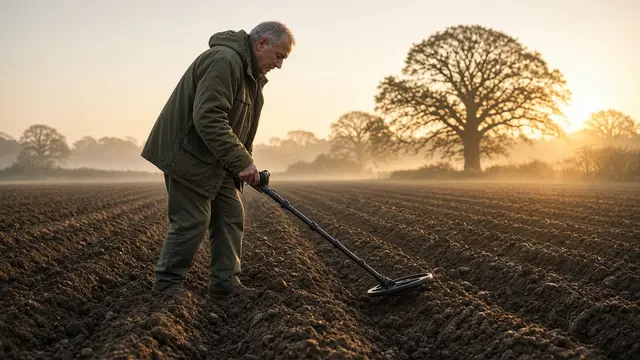
You don't need a €1,000 machine, a club membership or anyone's secret spots to start metal detecting. You need a modest detector, permission for one piece of ground, and a little research. This guide covers all three, in the order that actually matters.
How a metal detector works (in one minute)
The coil at the bottom generates a magnetic field. When that field passes over metal, the metal produces its own tiny field in response, and the coil picks it up. Different metals respond differently, which is why your machine can guess "iron nail" versus "coin" before you dig — that guess is the number or tone it gives you (called target ID).
Two beginner-relevant truths follow from the physics: detection depth is modest (a coin-sized object is typically findable down to roughly 15–25 cm, not metres), and mineralised soil and trash confuse the signal — which is why ground balance and discrimination settings exist. Every modern beginner machine handles both automatically.
What to buy — and what to skip
The honest answer: in 2026, any current entry-level detector from a known brand (Nokta, Minelab, Garrett, XP, Quest) is good enough that the machine will not be your limiting factor. Your spots will be. Rough budget guide:
| Budget | What you get | Verdict |
|---|---|---|
| Under €80 | Toy-grade detectors | Skip. Frustration in a box — they find bottle caps at 5 cm and nothing else. |
| €150–€350 | Entry machines from real brands | The sweet spot. Waterproof coils, target ID, auto ground balance. |
| €400–€800 | Mid-range, multi-frequency | Worth it once you know you love the hobby; better on beaches and trashy ground. |
| €900+ | Flagship machines | Buy with your second season's experience, not your first enthusiasm. |
What you actually must not skip:
- A pinpointer — a handheld probe that finds the target inside the hole. Saves ten minutes per dig. The single best accessory money buys.
- A proper digging tool — a sturdy trowel or small spade that cuts clean plugs.
- A finds pouch — one pocket for finds, one for the trash you dug (take it home; it's part of the deal).
- Headphones — you'll hear faint, deep targets you'd otherwise walk past.
The law: permission first, always
This is the part that keeps the hobby alive, so it goes before technique. Rules differ per country — we keep per-country guides — but the universal core is:
- All land belongs to someone. Private fields need the owner's permission. Public land has its own rules — often a permit, sometimes a ban.
- Protected sites are off-limits everywhere. Scheduled monuments, registered archaeological sites and their surroundings. Research around them, never on them.
- Significant finds must usually be reported. Many countries have treasure laws (the UK's Treasure Act, finder-reporting schemes like the PAS in England & Wales, PAN in the Netherlands). Reporting isn't just legal — it's how your find becomes part of history instead of a trinket in a drawer.
Where to search first
Beginners burn out in parks full of ring pulls. Here's the realistic ranking of beginner ground:
- Pasture with permission. The best beginner ground in existence. Grass fields that haven't been deep-ploughed keep finds at detectable depth, and a single old farm's surroundings can produce coins from four centuries.
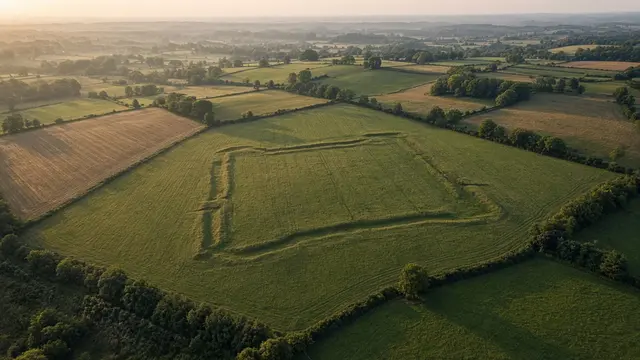
- Your own research spots. A vanished building on an old map, a footpath crossing on LiDAR — even a modest one beats a random field (see the full research method).
- Beaches, where legal. Fresh losses, easy digging, and storms reshuffle the deck. Check local rules — many beaches are fine, some need permits.
- Parks and playgrounds, where allowed. Modern coins and the occasional ring. Good swing practice, low history.
Find your first real spot tonight
TreasureCompass is a free research map: LiDAR terrain, historical maps and ancient-site layers for your own area, in your browser, no account needed. Most people spot something interesting within minutes.
Open the free map →Technique: the five habits that find more
- Swing low and slow. The coil should skim the grass, level through the whole arc. Lifting at the ends of the swing (everyone does it at first) loses half your depth exactly where you're not looking.
- Overlap every pass. Your coil only "sees" a cone below itself. Move half a coil-width per step, like mowing a lawn.
- Dig the iffy signals while you learn. For your first ten trips, dig everything repeatable. It calibrates your ears faster than any YouTube video. Later, you'll skip the obvious iron.
- Cut plugs, not craters. Three-sided flap of turf, fold it back, replace it so nobody could tell. This habit alone decides whether detectorists stay welcome on that land.
- Track where you've been. Record your GPS track and grid the field methodically. A season of "never the same ground twice" outperforms a season of wandering by miles — literally.
Your first finds: what's normal
A normal first month: shotgun caps, foil, a horseshoe, modern coins, a buckle, a mystery blob ("partifact"). That's not failure — that's soil doing what soil does. The hobby's rhythm is long quiet stretches punctuated by a moment you'll remember for years: your first silver coin coming out of the plug, dated three hundred years before your country existed. Everyone who stuck with it has that story. Research shortens the wait.
Beginner FAQ
Is metal detecting legal?
In most countries yes, with conditions: landowner permission, no protected sites, and in some places a permit or regional rules. Check our country guides and your local law before your first trip.
How deep do metal detectors go?
For coin-sized targets, roughly 15–25 cm with entry machines in average soil; large objects (cauldrons, hoards in pots) can be detected deeper. Anyone promising "2 metres on a coin" is selling something.
Do I need a license?
Depends on the country and even the region: England needs landowner permission (plus reporting finds under the Treasure Act), the Netherlands allows detecting with conditions under the Erfgoedwet, several German states require a formal permit (Genehmigung), and France requires authorisation for anything heritage-related. When in doubt, ask the local authority — and always ask the landowner.
What's the best time to go?
After ploughing and after rain (fresh surfaces, better signals, easier digging), and on beaches after storms. Winter pasture beats summer crops — you can't detect through standing crops anyway.